THE LENS LIBRARY

Art of Lens

A lens is a small, beautifully engineered disc that sits between your eyes and the world. Long before it reaches your face, dozens of tiny choices are made for you — and most of them come down to four simple questions: what kind of lens, which index, which feature, and which coat?

01Lens Family02Index03Feature04Coat
Scroll

ONE

Which Lens Starts With Your Eyes?

Most prescriptions fall into one of three families. Find your family first, and the rest of this page becomes much easier to read.

Single Vision

One prescription. One focus. The clearest, simplest lens you’ll ever wear.

A single-vision lens provides the same correction across the entire lens—edge to edge. With no zones to adapt to and no learning curve, your vision stays wide, natural, and comfortable from minute one.

Everyday wear · Distance · Reading · First prescription
Progressive

Three distances. One seamless lens. No more switching glasses for reading, computer, or distance.

The eye’s natural lens loses flexibility with age—a condition called presbyopia. A progressive lens blends near, intermediate, and distance vision across a single continuous surface, so you see the way you always have—while looking just like an ordinary lens to everyone else.

Presbyopia · Desk and screen days · Moving between distances all day

Non-Prescription

Zero correction, full protection. Designed for those who don’t need vision correction—but make eye care a daily self-care ritual.

Zero prescription. Still a lens. If you don’t need correction, it’s all about what else the lens can do: blue-light filtering, photochromic tinting, polarized glare reduction, and the same coatings you’d get on a prescription lens.

Screen time · Driving · Outdoor days · Kids' glasses

The corridor decides how a progressive feels

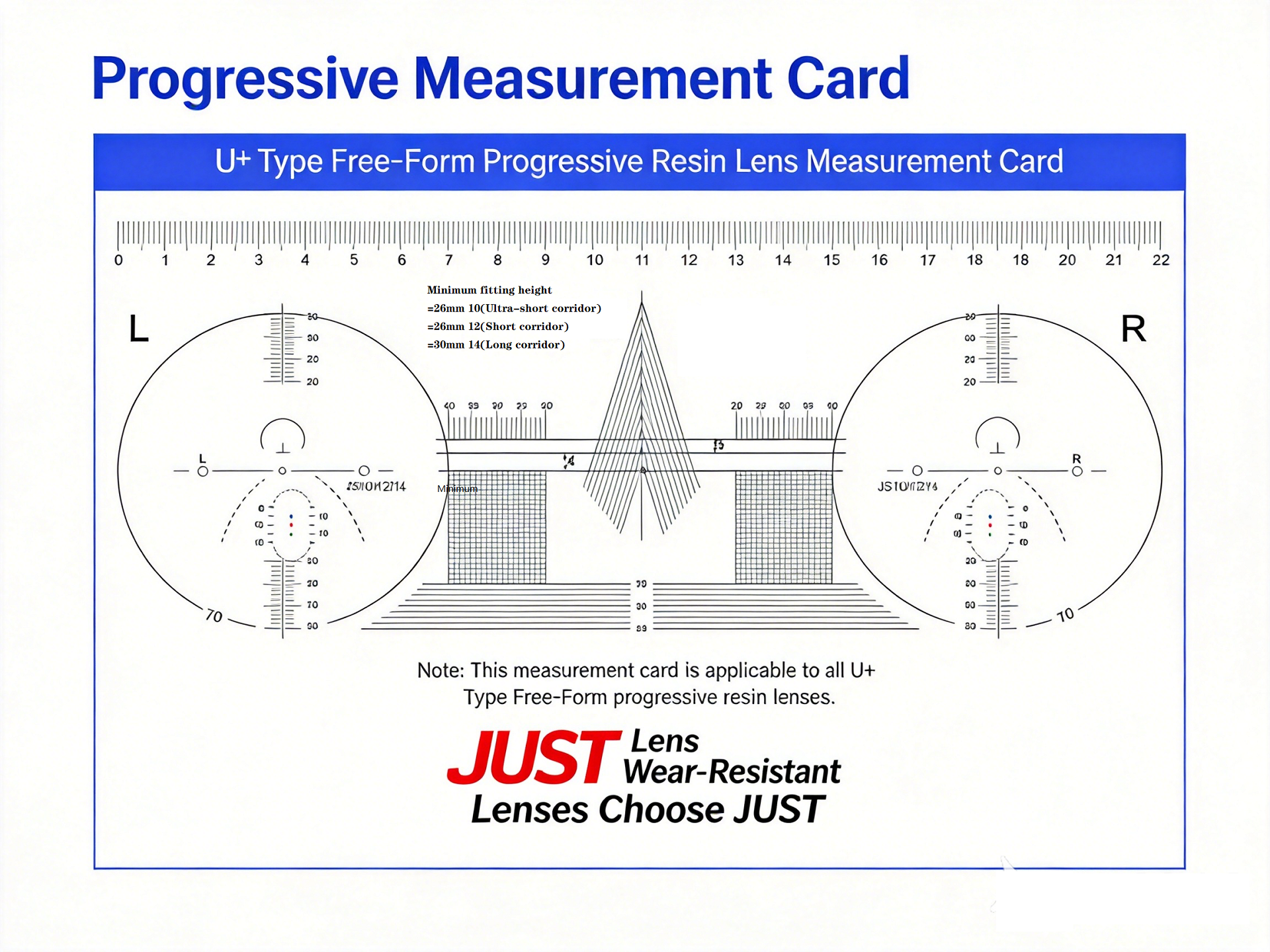
Progressive measurement card

Thin (narrow) corridor

Compact and fast to learn. A smaller sweet spot — ideal when your day lives at one distance.

Wide corridor

More room between distance and near. It doubles down on comfort as your focus shifts between screens, paper, and conversation. Transitions between zones are smooth and natural—no image jump—so distance, intermediate, and near vision all stay comfortable, with a wider, more open field of view.

U+ corridor

Developed with the School of Optoelectronics at Soochow University. The U+ internal progressive lens uses an optimized inset design for a wider, flatter corridor—so even first-time wearers enjoy smooth, comfortable vision. It’s engineered to feel virtually invisible from day one.

Corridors are not better or worse — they are about fit. Your daily rhythm tells us which one disappears for you.

TWO

Finding the Index That Fits You

The refractive index measures how strongly a lens material bends light. The higher the number, the thinner and lighter your lenses can be—for the same prescription.

IndexWhat it doesBest for
1.57The entry-level standard. Clear, reliable optics at a friendly price.Combined power below 4.00
1.59A step up from 1.57 for everyday wear — lower density, so the finished lens sits lighter on the frame.Combined power 4.00 – 5.50
1.61 MRA mature high-index MR-class resin. Visibly thinner than 1.59 while color and clarity stay naturally neutral.Combined power 5.75 – 7.00
1.61 PUOur own polyurethane formula. The same 1.61 index with a genuinely balanced blend of clarity, toughness and comfort.Combined power 5.75 – 7.00 · Rimless-friendly
1.67 MRA high-index MR-class resin: a slim, light profile with well-controlled edge artefacts.Combined power above 7.00
1.67 PUOur own high-index polyurethane: the same slim 1.67 profile, with the smooth surface our coatings grip well.High prescriptions in fashion frames

Before you compare — find your combined power = |sphere| + |cylinder|. SPH

THREE

Features are choices, not upgrades

Each feature solves a different daily problem. Pick what your routine actually needs — most glasses pair one or two at most.

Blue Cut

A precise filter for the intense short-wavelength blue light that screens pour out. Color stays honest — nothing in the view goes yellow on you.

Driving Lens

A contrast-tuned driving filter. Glare from rain, low light at dusk, and oncoming headlights is reduced, while signals, signs, and road markings remain sharp and easy to identify. When driving at dusk or at night, it effectively reduces glare from oncoming headlights, supporting clearer vision and safer driving.

Photochromic

Clear indoors, darkening outdoors as UV builds, then fading back when you step inside. One honest pair for every light.

Color Tint

A fixed shade across the whole lens — from soft smoke greys to deep, confident fashion colors. Style and sun relief in a single lens.

Polarized

A layer that stops the flat glare skipping off water, snow and wet tarmac, so views read calmer, deeper and richer in color.

How they combine

  • Blue Cut stacks with everything except Polarized.

FIVE

Anti-reflective coating

Removes the reflections bouncing off the surface of the lens — the light other people see, not the light you see.

The color on a coated lens is reflected light — the small slice of the spectrum the coating lets go. It is not a tint inside the lens; it signals how the layers are tuned, and which pair belongs to which life.

Forest Green

A natural, easy-on-the-eye green flash. The most neutral of the four, and the highest overall transmission.

Daily life, driving, hiking — the safe all-rounder.

Air Blue

A calm, almost-whisper of pale blue. The lowest residual reflection of the set.

Meetings, lectures, on-camera work, photography.

Crystal Blue

A crisp, cool blue flash with a technical, modern edge.

Offices, long screen hours, design and detail work.

Era Golden

A warm golden glow that softens harsh light and lends a vintage, luxurious presence to the frame.

Business, formal and evening wear — warm climates too.

SIX

Top coating

The last, outermost finish — a low-energy skin that decides how water, grease and dust behave on the surface.

EMI Shielding

A conductive layer that reduces the electromagnetic field around the lens — a quiet comfort for people surrounded by devices.

Hydrophobic

A low-energy top layer. Water beads into perfect drops and rolls off; fingerprints and oil lift away without rubbing.

Hydrophobic is standard on every CBC lens. It's a slow-burn advantage you notice a year in, not on day one.

EIGHT

Quick answers, straight to the point

Q1How do I know which lens family I need?

Read your prescription. A single number usually means a single-vision lens. If you see an ADD or near values in the lower half, a progressive lens is usually the better companion.

Q2What is the combined power, exactly?

It is your sphere plus your cylinder, added from the same eye. Compare both eyes, then use the larger value when you pick an index in the table above.

Q3Will photochromic lenses stay clear at a screen?

They darken with ultraviolet light, not with screen light, so indoors they stay nearly clear. That makes Blue Cut the feature for screen-heavy days, and photochromic the feature for the outdoors.

Q4Does the AR color change how I see?

No. The color you notice on the surface is a reflection — a tiny slice of the spectrum bouncing off. It never tints the view in front of you.

Q5How long until a progressive lens feels normal?

Most people stop thinking about it within a few days. Wide and U+ corridors get there fastest — the first day or two is the only honest exception.

SEVEN

Not sure which combination is yours?

Two minutes with MINICBC is faster than reading all of this. Describe your days — screens, roads, sports or classrooms — and it will ask the three questions that matter, then hand you back a shortlist.

Ask MINICBC